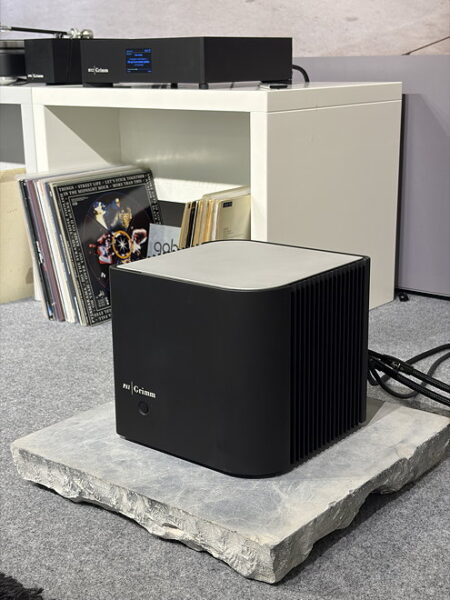
With the PA1, we proudly present an amplifier that offers a musicality like found in the best tube based designs while simultaneously challenging the rock-solid performance achieved with the best solid-state designs. Notwithstanding its relatively compact shape, the PA1 delivers more than 200 W into 4 Ω, and is capable of driving even the most demanding loudspeakers with ease. This paper provides insight into a number of the key elements involved in achieving this.
One of the most striking design choices in the PA1 is found in the output power stage. It is a traditional ‘class AB’ type of design, but of a highly innovative kind. We created a fully symmetrical circuit, with no less than 96(!) small and fast power transistors to achieve a very high bandwidth. This unique technique became possible by using modern aluminium printed circuit board technology, that offers an extremely tight thermal coupling of all the power transistors. An ingenious output driver circuit, mounted on the very same aluminium printed circuit board, takes care of the quiescent current setting point of the output stage transistors.
The circuit is an evolution of an original design by the late Henk ten Pierick, dating back to 1985. His concept provides an extremely well defined power output stage setting point, through which the output stage impedance remains constant over the full cross-over region, resulting in the lowest possible distortion of dynamic signals. The tight thermal coupling of the output stage transistors with the driver stage ensures that this ideal setting point is maintained even when large (low-frequency) currents are delivered to the loudspeaker. The PA1 name refers to Henk’s genius, we call it the “Pierick Amp”.
The importance of an extremely stable cross-over region in the transfer curve can hardly be over-estimated since by nature music signals contain large amounts of low-frequency content. These modulate the temperature in the output transistors which causes an offset to the amplifier’s optimal biasing via thermal runaway. The resulting type of distortion is not identified using standard 1kHz THD measurement methods, but even small changes in the cross-over distortion footprint of an amplifier are audible and degrade true fidelity. The tight thermal coupling of all output devices in the PA1, combined with their clever driving circuit design, prevents such problems fundamentally ‘by design’.
Phase modulation
Another type of often overlooked distortion is phase modulation – effectively resulting from the speed of the circuit varying with the amplitude of the audio signal. Similarly as with the cross-over distortion, phase modulation causes a distortion profile that varies as a result of the different frequency components in the music signal. For instance the (usually large) low frequency components of a bass instrument can cause time smearing in the higher frequency components of instruments and voices. In the power stage as well as in the other signal stages of the PA1, this type of distortion is kept extremely low, which is achieved through dedicated design techniques, including feedforward corrections.
Now we have this highly optimized and fast amplifier circuitry, an appropriate amount of global feedback is applied. We developed a second order feedback loop for the PA1, which brings down the last small remainders of distortion. Our very careful and unique design of this feedback circuitry – again preventing phase modulation and thermal errors also in this part –, further strengthens and adds to the fidelity of the amplifier.
Further optimizations
In addition, the input signal path is designed without using series coupling capacitors, preventing any audio degradation of the incoming signal. A meticulously optimized board layout using multilayer PCBs preserves the input signal integrity. The input signal routing to the circuitry is maximally short, just like the critical part of the output signal wiring. To prevent any further degradation of the amplified signal, the clever protection circuitry of the PA1 is designed such that the use of series relay contacts in the amplifier output signal could be omitted.
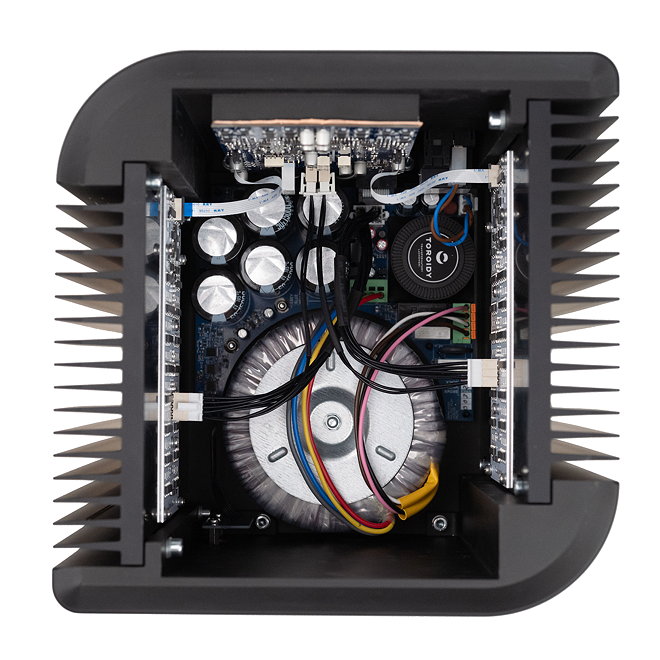
The large Amplimo toroidal power supply transformer ensures an absolutely minimal capacitive coupling from the mains rails, while providing current in abundance. The transformer current is buffered using a massive 90.000uF(!) supply decoupling capacitance. In addition, the supply of the driver and feedback circuitry is stabilized locally, ensuring a perfectly stable operation that is independent of the output current drawn by the loudspeaker.
The result of all this is absolute pristine audio playback with an extreme authority in the bass, true to life mids and clean transient highs. There’s crispy speed and clarity, and micro-details fall in place naturally. The PA1 offers you that feeling of ‘being there’ rather than of listening to a playback system.
Key performance figures of the PA1:
- Power: 200 W in 4 Ω
- SNR: 96 dB (1 W, 8 Ω)
- THD: <0.0001 %
- Damping Factor: >800 re 8 Ω
- Frequency response: 0.1 Hz – 300 kHz
- Weight: 15 kg
- Dimensions: w x d x h: 250 x 250 x 240 mm